Admin work is eating 25% of your week. Here's what it actually costs.
Ask a business owner how much of their week goes to admin and most will say about ten hours. Time-tracking data says otherwise. When Clockify and Toggl analyzed roughly 600,000 founder time records, the people who said ten hours were logging fourteen to sixteen. That gap is the story of this post.

Why does admin feel smaller than it is?
Because it never shows up as one block. It is the inbox sweep before the first call. The follow-up you re-send because nobody answered. The scheduling back-and-forth. The invoice you build by hand. Each one is a few minutes, so none of them register. Add them up across a week and NFIB's survey data shows 73% of small business owners name administrative workload as their number one time drain, above hiring, compliance, and cash flow.
The same research shows owners average 49 hours a week but think they should be working 42. The seven-hour difference is almost exactly the admin they are not counting.
What does 15 hours a week actually cost?
Put your time at $100 an hour, which is conservative for anyone who closes deals or manages a team. Fifteen hours a week of admin is $1,500 a week and roughly $75,000 a year of the most expensive labor in the building doing work that does not need it. That is before counting what the hours displace: the client you did not follow up with, the renewal that went out late, the quote that sat for three days.
What does it look like when you fix it?
Between May and August we built 23 systems for a property management company on the Central Coast. Not a software rewrite. Automations on top of the tools they already paid for: their email, their property software, their spreadsheets. Every system charges the time a person spends reviewing and approving the output, because nothing goes to a tenant or an owner unreviewed.
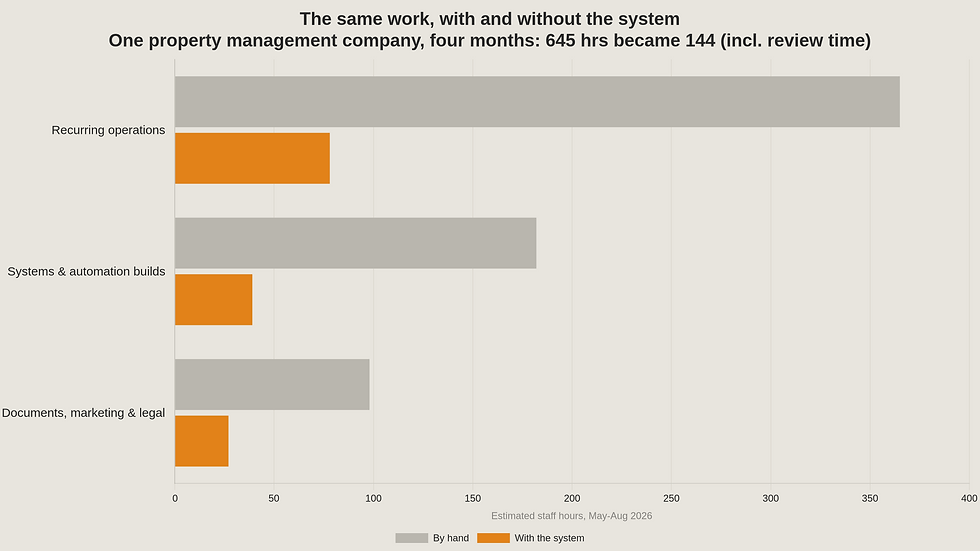
Work that would have taken an estimated 645 staff hours by hand took 144 with the systems in place. 501 hours returned to the team in four months, same headcount. Three examples show the pattern:
Daily maintenance report. A two-hour manual sweep of the maintenance inbox became a generated 18-section report the team reviews in twenty minutes. Runs every working day. 117 hours back.
Lease renewals. 165 owner outreach drafts generated from a software export and the team's own shorthand, then reviewed by a person. Renewals now go out weeks ahead instead of days. 38 hours back.
Litigation support. Years of email reconstructed into a maintenance chronology, an evidence register, and a settlement exposure analysis. 60 hours of work done in 18, on a deadline.
These are estimates, not timesheets. The counts of work performed are real. The per-task times are conservative judgment calls, stated so they can be challenged.
What should you automate first?
Not the flashy thing. The boring thing that happens every day. The single biggest return in that project was the daily report, because daily compounds. Look for a task that meets three tests: it happens at least weekly, the inputs already live in a system you own, and a person can review the output in a fraction of the time it takes to produce it. That is where the hours are.
If you own a business in SLO County and want to know what that task is for you, we do a free systems audit. We tell you what is worth automating and what is not. A person replies within 48 hours.


Comments